The Value of VGI
The economic, reliability and affordability case for vehicle-grid integration in Canada.
There is broad consensus that electricity will play a central role in Canada’s prosperous, low-carbon future. The challenge is increasingly not whether the electricity system must transform, but how to make that transformation affordable, reliable and achievable at the scale and pace required. Vehicle-grid integration (VGI) – including managed charging and bidirectional charging – is a critical part of that answer: it can turn one of the largest new sources of electricity demand into one of the system’s largest sources of flexibility.
EVs: A Grid Resource Hiding in Plain Sight
Canada is preparing to double the size of its electricity system by 2050, requiring more than $1 trillion in investment. At the same time, millions of electric vehicles (EVs) are arriving in Canadian driveways and parking lots: If enabled by VGI, those vehicles can help meet the electricity system's growing needs, rather than adding to them.
Unlike many other large electricity loads, EV charging is inherently flexible. Personal vehicles spend about 95% of their time parked, and their batteries are typically sized for trips much longer than most daily driving. Nearly half of Canadians have a daily commute of less than 60 km round-trip, while many new EVs offer 400–500 km of range. For most vehicles on most days, there is therefore considerable flexibility in when charging occurs – without affecting the driver’s mobility.
And that flexibility extends beyond when EVs consume electricity. EVs are batteries on wheels: when paired with bidirectional charging solutions, EVs can act as energy storage resources to support homes, businesses or the electricity system when needed. EVs store around 4-8x the energy of a typical residential battery system, enough to power an average home for several days or support critical winter heating loads during an outage. By 2030, Canada’s light duty EV fleet is forecast to contain more than ten times the capacity of stationary batteries nationally. Accessing the flexibility of that storage capacity when it’s not being used for transportation is an enormous potential grid resource.
With 60-80 kWh batteries – 4-8x the size of a typical residential storage system – the over 4 million light-duty EVs on Canadian roads in 2030 could add more than 275 GWh of battery capacity.
The strategic question is therefore not simply how Canada will build enough electricity infrastructure to accommodate millions of EVs. It is how much infrastructure investment can be avoided, deferred or better utilized by treating those vehicles as part of the electricity system — and, in doing so, increasing the affordability, sustainability and reliability of energy for all Canadians.
A significant economic opportunity
VGI creates a rare three-way value proposition across the electricity, automotive and customer ecosystems.

Utilities
The electricity system gains a cost-effective, flexible resource while freeing grid capacity for other loads and economic growth.
Automakers and technology providers
Automakers and technology providers can strengthen and differentiate their customer value propositions, accelerate sales and gain access to new revenue opportunities.

Customers
EV drivers can benefit from lower charging costs, backup power and compensation for providing grid services. Previous Dunsky analysis for Canadian utilities suggests that participating in bidirectional charging programs could provide compensation to EV drivers on the order of $1000 per year.
Dunsky has supported utilities across Canada in quantifying potential load growth and flexibility from EVs, and has consistently found that VGI can substantially improve the economics of accommodating EV load growth — reducing or deferring grid investments while making better use of existing infrastructure. These benefits can shift the equation entirely. On average, the increased revenue and improved grid utilization attributable to EVs more than offset the cost of required grid investments.
Dunsky analysis for Electric Mobility Canada in 2025 found that, with managed charging, meeting light-duty EV demand could require about $48 billion in Canadian grid investment between 2025 and 2040, while generating about $71 billion in additional utility revenue and putting downward pressure on electricity rates.
The window to act is now
This opportunity will not materialize automatically. Vehicles, chargers and utility systems purchased or built today can remain in service for years or decades, while programs developed today can shape outcomes well into the future. Utilities and regulators likewise make infrastructure and planning decisions over long time horizons.
Waiting until EVs reach mass scale to determine how they should interact with the grid risks locking in infrastructure, technology and market choices that are difficult and costly to change later.
Canada is already moving from concept to deployment. Managed charging programs are emerging across the country, bidirectional charging technologies are being piloted, and major automakers are introducing vehicles offering bidirectional charging features. The core technologies increasingly exist. The challenge is now to create the conditions for them to work together at scale.
That requires coordination across sectors on questions such as:
- how vehicles, chargers and grid systems communicate and interoperate;
- how the full value of VGI is assessed and compensated;
- how utilities design programs that work for customers and market participants; and
- how regulatory and interconnection frameworks enable, rather than impede, scalable deployment.
The next several years will therefore be critical. The choices made now will determine whether Canada captures the full value of millions of EVs as part of its future electricity system or treats them primarily as another costly source of demand to be accommodated.
Capturing the value of VGI requires coordination
Despite its potential, VGI is not yet scaling in Canada. Progress remains constrained to small pilots and limited programs due to fragmented technical requirements, regulatory and business case uncertainty, limited product availability, and a lack of coordinated efforts across service territories and jurisdictions.
No single organization can overcome these barriers alone. Utilities, automakers, charging providers, regulators, and other market players need to align on how VGI technologies interact with the grid, how their value is assessed and compensated, and how effective strategies can be expanded across different markets.
The Canadian VGI Alliance brings these organizations together to help shape the emerging VGI landscape. By developing shared tools, implementation guidance, knowledge sharing, and strategic coordination, the Alliance aims to transition VGI from isolated pilots to scalable, investable solutions. Through it, members will have a chance to collaboratively influence the frameworks, standards, and compensation mechanisms that will define VGI development in Canada.
WHY VGI?
Understanding the Electricity Grid 101
The electricity system is sized to meet peak demand, even though those peaks occur only a few times each year. Reducing peak demand therefore creates significant opportunities for utilities to reduce costs. In much of North America, including Ontario and Alberta, peak demand occurs on late summer afternoons when air-conditioning use is highest. In the rest of Canada, peak demand occurs, or is increasingly shifting to, the coldest winter days as electrification increases.
This helps explain both the challenge and the opportunity EVs present to the grid. Adding an EV charger can double a home’s power draw, potentially increasing demand on upstream grid infrastructure. However, EVs are also highly flexible loads: customers generally care that their battery is charged when they need to drive, not exactly when that charging occurs.
With managed charging alone, EV loads could require about $48 billion in upgrades from 2025–2040, but utilities could earn $71 billion from increased sales – more than covering costs (EMC & Dunsky, Powering Up: National Report, 2025).
Bidirectional charging (V2G) can provide even greater value. While managed charging can reduce or shift the peak demand created by EV charging, V2G allows EVs to discharge power back to the grid and help meet broader system needs. The value to the grid from a vehicle participating in V2G is on the order of 8x the value of managed charging alone. Bidirectional charging can also provide backup power to homes and buildings during outages, and enables EVs to be used as mobile power hubs such as on construction sites and camping trips.
Automakers and Technology Providers
EVs are creating new relationships between the automotive and electricity sectors that previously had little need to coordinate. VGI provides an opportunity for automakers and technology providers to turn what could otherwise be a grid constraint into grid benefits, additional customer value, and potentially new revenue.
The value VGI provides to utilities can, in turn, create value for customers who participate in VGI programs. EV drivers have the potential to obtain “free fuel for life” by offsetting their charging costs with compensation from VGI participation. For automakers and technology providers, enabling access to this value creates an opportunity to strengthen customer relationships, differentiate products and services, and improve the overall value proposition for switching to an EV, as well as opening up new revenue and business model opportunities. The value chain will require many enabling roles, including software integrations, aggregation services, and customer acquisition, which each represent potential revenue capture opportunities.
The key challenge for automakers and technology providers in enabling VGI is greater clarity and consistency around interoperability, standards, interconnection rules, and compensation mechanisms that support a clear customer value proposition. Global automakers design products for continental-scale markets, so differing requirements across individual utilities are a major barrier. However, Canada’s vehicle market is comparable in size to California’s, making a harmonized national market a materially more addressable opportunity. The Alliance’s Phase 1 efforts will include developing frameworks for assessing the full VGI value stack, alongside guidance on compensation, standards and coordinated approaches to increase market certainty.
Utilities
VGI is a flexible grid resource that can be valued and evaluated like other distributed energy resources (DERs). Managed charging (V1G) is comparable to other flexible-load programs like thermostats, while V2G can provide services similar to stationary batteries using vehicle batteries that have already been purchased primarily for transportation.
For utilities, VGI can be a tool for managing the cost of electrification. This is particularly important because EV adoption tends to cluster and create localized constraints that might otherwise require upgrades to transformers, feeders, or other grid infrastructure. VGI can also be a tool to mitigate customer connection constraints and costs. Even utilities that do not face significant generation capacity constraints may therefore find value in VGI at the distribution level.
The specific value VGI can provide depends on the utility’s or region’s grid needs, as well as when and where those needs occur. Like other DERs, VGI can provide a range of benefits across the electricity system, including generation, transmission and distribution capacity, energy, emissions reductions, ancillary services, customer capacity, and resilience. Together, these benefits form the VGI value stack.
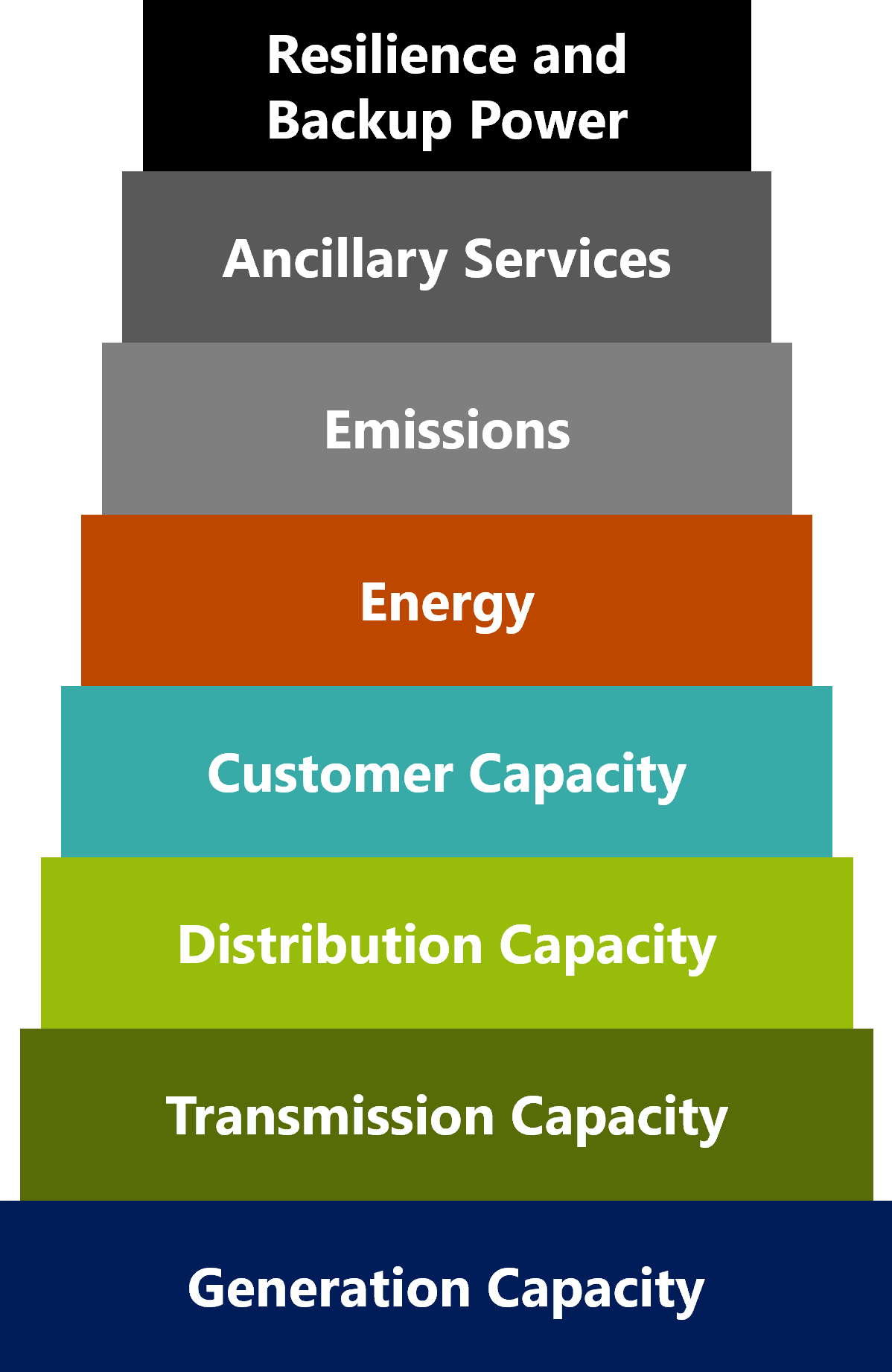
Generation capacity value
Refers to reducing the amount of generation capacity required to meet system peak demand, either by lowering charging demand during peak periods or by supplying power from EV batteries.
Transmission capacity value
Reflects the benefit of reducing coincident peak demand on upstream transmission infrastructure.
Distribution capacity value
Reflects the benefit of reducing localized peak demand on distribution infrastructure, potentially avoiding or deferring upgrades to feeders, transformers, and other assets.
Energy value
Reflects the benefit of shifting electricity consumption away from higher-cost periods or, through bidirectional charging, supplying energy when it is most valuable to the grid.
Emissions value
Reflects avoided emissions from shifting charging to periods with lower-emissions electricity supply or reducing reliance on higher-emitting generation.
Ancillary services
Include grid services such as frequency regulation and operating reserves that can help maintain system balance and reliability.
Customer and connection capacity value
Includes opportunities to manage customer or site-level capacity constraints, such as through peak-demand management or flexible connections.
Resilience and backup power value
Reflects bidirectional EVs' ability to provide power to homes, buildings, or other loads during outages or other disruptions.
Capturing these benefits requires understanding where, when, how much and for which grid services VGI provides value. The optimal application will differ across utilities and across locations within a utility’s service territory. In some areas, the primary opportunity may be managing generation peaks; in others, it may be avoiding a distribution upgrade, managing a constrained customer connection, or improving resilience.
The main challenge is translating this technical potential into deployable grid solutions and compelling customer value propositions. Utilities need practical valuation frameworks that can recognize the full value stack, along with compensation mechanisms, technical standards, program designs, and regulatory pathways that allow VGI resources to participate as a cost-effective grid resource on a level playing field.
The Alliance’s Phase 1 efforts will include developing frameworks for assessing the full VGI value stack, as well as guidance on compensation mechanisms, standards, and regulatory pathways needed to quantify and capture that value effectively.
