The VGI Ecosystem
Standards, regulatory pathways and coordinated deployment practices.
The VGI Ecosystem: How the Pieces Fit Together
Scaling VGI requires more than capable vehicles and chargers. It requires several parts of the ecosystem to advance together:
- compatible technology and standards
- streamlined interconnection and regulatory processes
- utility planning and operational readiness
- viable programs and compensation mechanisms
- a customer value proposition that makes participation worthwhile and easy.
Progress does not need to occur everywhere at once. Different jurisdictions and organizations are starting from different levels of maturity. For example, managed charging can often advance ahead of bidirectional applications, and early adoption of both can be enabled through existing programs and simple communication flows which evolve into fully-optimized, DERMS-enabled approaches by the time total market size warrants it. It is also essential to incorporate VGI in planning and forecasting, including quantifying its potential, so that utilities, policy-makers and industry can make informed investment decisions, and can work backwards from longer term goals to inform what needs to happen and by when to reduce uncertainties and enable VGI to scale on a relevant timescale. The goal is to identify the barriers most relevant to each use case and begin building the capabilities needed for scale.
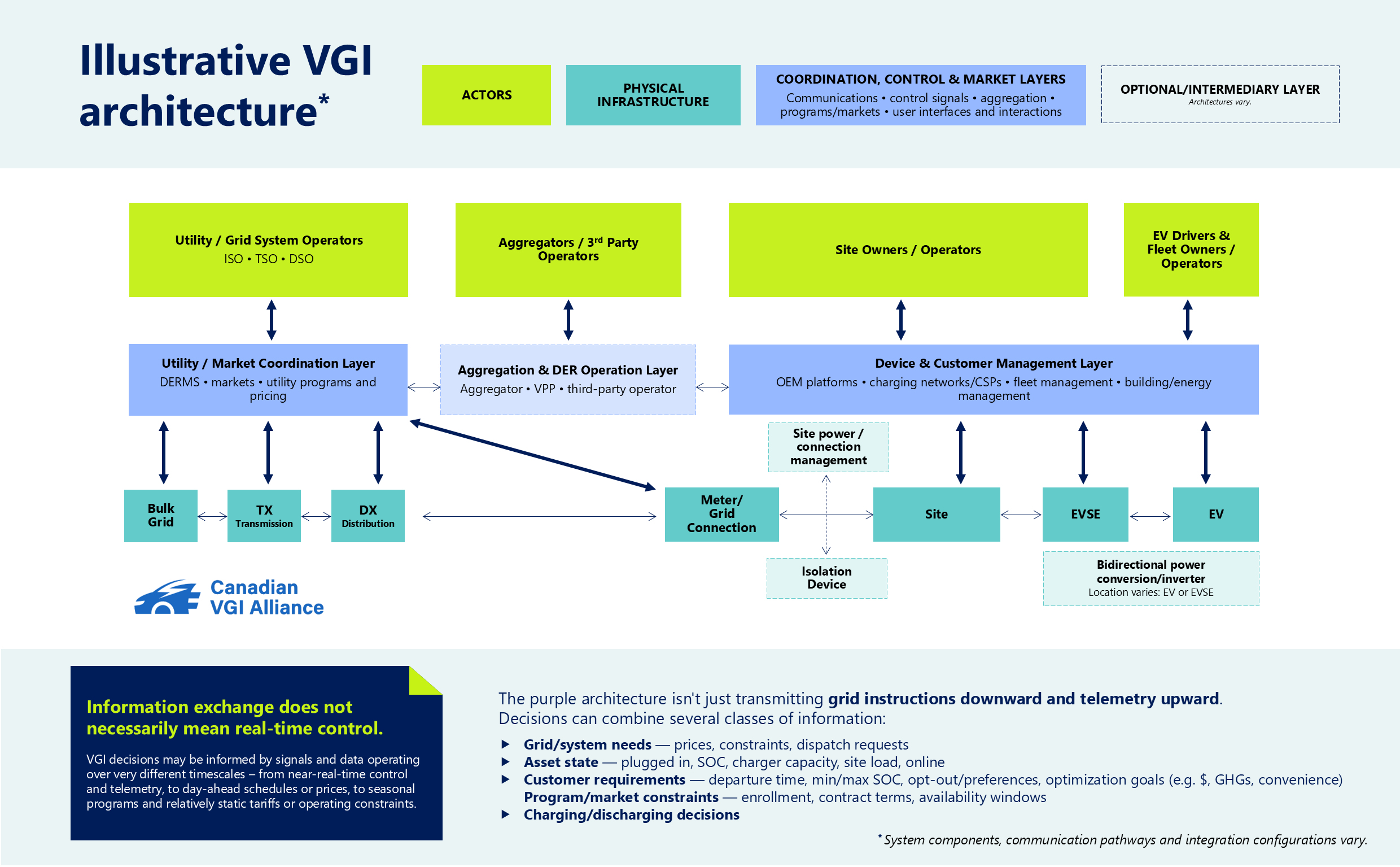
For vehicle-grid integration (VGI) to move from technically possible to practically scalable, several systems need to work together seamlessly. The communication pathway typically includes, but is not limited to:
System components in the communication pathway
- Electric vehicle (EV): communicates battery state, charging capability, operating limits and mobility needs, and carries out charging and discharging instructions.
- Charging equipment (EVSE): manages the physical connection to the grid and carries out charging or discharging instructions.
- Site or fleet energy management system (EMS): coordinates EV charging with building loads, fleet schedules and site electrical limits.
- Device management platforms: including charging networks/CSP platforms, OEM telematics platforms, fleet management systems and building energy management systems, which manage individual devices and customer or site constraints.
- Aggregators or third-party operators: combine vehicles, chargers, or sites into a coordinated resource that can participate in utility or electricity market programs. Some device management platforms may also act as aggregators. Communication pathways do not always include an aggregation or third-party operation layer and may also involve multiple.
- Utility/market coordination systems: including utility-facing DERMS (DER Management Systems), utility program platforms, and market systems, which receive resource availability or registration information and translate grid or program needs into prices, schedules, operating limits or dispatch requests, and, where applicable, enable aggregated VGI resources to qualify, provide and be compensated for electricity services.
- Grid system operators: identify local distribution, transmission or bulk-system needs, establish operating constraints and assess how VGI resources respond.
Information must move reliably in both directions. Vehicles and charging systems send information such as availability, equipment status, metering and delivered performance upstream, while prices, schedules, power limits and dispatch instructions flow back toward the vehicle.
Making this work at scale requires more than technical connections. Common communication standards, interoperability, cybersecurity, customer authorization, reliable metering and clear settlement processes are needed across the full pathway. Without them, individual VGI demonstrations may function well, but deploying thousands or millions of participating vehicles becomes difficult and costly.
Interoperability is what makes VGI scalable
Interoperability is essential for VGI to move beyond individual demonstrations and become a repeatable, scalable grid resource. Vehicles, chargers, site or fleet controllers, aggregators and utility systems all need to exchange information reliably and act on it consistently.
Interoperability is not simply about whether two systems can “talk” to one another. It means ensuring that the full VGI technology stack can communicate, interpret information, operate safely and participate in grid programs across different technologies and jurisdictions. This applies to both managed and bidirectional charging.
The five layers of interoperability
1. Communication protocol interoperability
Vehicles, chargers, charging platforms, aggregators and utilities may use different communication protocols at each interface. These protocols need to connect and exchange the required messages reliably across the end-to-end VGI pathway.
2. Data and semantic interoperability
Information also needs to retain the same meaning as it moves across those interfaces. Consistent definitions, or reliable translation between data models, are needed for items such as power direction, limits, operating states and grid-support functions.
3. Equipment and system interoperability
VGI can be implemented using different equipment configurations and system architectures. For example, power-conversion and grid-support functions may be carried out by the charging equipment or by the vehicle directly. Managed charging can be implemented via the EVSE or via the EV. A scalable framework must accommodate different compliant configurations while ensuring the vehicle, charger, controls, and grid interface operate safely and reliably as a complete system.
4. Operational interoperability
A standards-compliant product does not automatically guarantee that it will work seamlessly with every other compliant product or software platform. Differences in how standards are implemented, optional functionality, and proprietary interfaces can still require additional testing or integration. Utilities and service providers therefore need confidence that VGI resources can be identified, controlled, monitored and verified consistently across different technologies. Utilities should not need to develop a custom integration for every vehicle model, charger manufacturer, or software provider.
5. Regulatory and process interoperability
Even technically compatible systems can face barriers if similar VGI configurations are treated differently across utilities or jurisdictions. Consistent terminology, equipment requirements, interconnection processes and certification approaches make it easier to deploy the same technology across multiple service territories.
Standards are necessary, but not sufficient
No single standard currently governs this entire pathway. Instead, different standards apply at different interfaces and layers. This means that the existence of standards alone does not guarantee interoperability. A vehicle may comply with one standard and a charger with another, while the combined EV–EVSE–software system may have never been tested end-to-end. Fragmentation, overlapping requirements, and limited end-to-end validation can leave gaps between otherwise standards-compliant components. Testing and certification therefore need to increasingly assess how the full technology stack performs together, rather than only whether individual devices meet separate requirements.
Building towards a scalable, interoperable system
Early V2X deployments may rely on proprietary integrations or a limited set of compatible vehicles and chargers. Over time, utilities, governments and fleet operators can accelerate convergence by favouring open standards and interoperable technologies in procurement and program requirements. OCPP provides one useful precedent: it began largely as an industry protocol adopted voluntarily by charging providers but has increasingly become an expected or required feature in charging infrastructure procurements.
The long-term objective is not necessarily for every V2X system to use exactly the same technology. Rather, it is to create an ecosystem where different vehicles, EV chargers, and software platforms can participate in utility and market programs without extensive custom engineering every time a new technology or provider is introduced.
Hardware Compatibility and Readiness
Although V2X market development has advanced considerably in recent years as more vehicle models and charging equipment have been introduced that offer bidirectional charging features, today’s market remains uneven, with support concentrated within a selection of models.
Automakers have signalled continued expansion of bidirectional charging features over the coming model years, with announcements as of September 2026 from several major manufacturers including Ford, GM, Nissan, Hyundai and Kia. Similarly, charging equipment providers have announced bidirectional charging products, including Wallbox, and dcbel. The list of available products regularly grows – the California Energy Commission maintains an approved equipment list which is regularly updated.
It is important to be aware that buying hardware marketed as ‘V2G-capable’ or ‘V2H-capable’ or ‘smart-charging capable’ does not mean that it can be used for that purpose. Enabling bidirectional charging requires a full chain of hardware and software components that are compatible with each other and are generally not designed to be enabled by customers without an established relationship with their automaker and/or aggregator. Similarly, an EV might have smart charging capabilities but still not be eligible to participate in their local utility program if their smart charger or EV company doesn’t integrate with that utility’s technology stack.
Certain medium- and heavy-duty vehicle (MHDV) segments are considered early grid-connected bidirectional charging applications because fleet vehicles charge at depots, follow predictable schedules, and are managed by a single owner. Vehicle use cases with time-of-use profiles that are complementary to the timing of grid needs include school buses, which are typically not in use during summer peak season, and last-mile delivery vehicles, which often return to base in the early afternoon.
Implications for Interconnection
Any electrical devices configured to discharge while connected to the grid, whether designed to export to the grid or just meet site load, are required to go through a utility interconnection process. Grid-isolated back-up power systems that discharge only when the site is electrically disconnected from the grid may not require interconnection approval, but do meet specific grid isolation safety requirements. V2X introduces new considerations for utility interconnection processes. While many existing distributed energy resource (DER) processes can accommodate bidirectional charging systems, they were generally developed around stationary generation and storage rather than the bidirectional charging industry, which comprises a mix of system types. Specifically, some bidirectional charging systems convert power off-board the vehicle, while others convert power on-board the vehicle, with stationary charging systems providing oversight for grid safety and interoperability.
A key challenge for V2X is determining what type of interconnection review a system actually needs. Terms such as V2H and V2G may appear in product marketing or certain customer communications, but they do not adequately describe how a system is used. Utilities need to know whether it discharges only when electrically isolated from the grid, in parallel without exporting past the customer site, or in parallel with net export to the local distribution grid. Clear classification can help avoid unnecessary reviews and inconsistent treatment.
Interconnection rules also need to accommodate different system designs while ensuring safe operation. The inverter may be located offboard or onboard the vehicle, and utilities need confidence that equipment, controls and anti-islanding protections will prevent unintended exports and meet applicable requirements.
Differences in technical requirements, fees and approval timelines add cost and complexity for manufacturers and service providers. Processes should also allow systems to change operating modes over time, such as moving from backup-only use to full grid-exporting participation, as long as the systems can meet the relevant requirements for interconnection.
The objective should not necessarily be to create a completely separate interconnection framework for V2X. Instead, utilities can build on existing DER and energy storage processes while establishing clear definitions, proportionate review requirements, recognized equipment pathways, and streamlined processes for the different ways bidirectional EV charging systems can interact with the grid.
Standards Landscape
The VGI ecosystem is supported by several standards organizations, such as:
- Institute of Electrical and Electronic Engineers (IEEE)
- Underwriters Laboratories (UL)
- Society of Automotive Engineers (SAE)
- International Organization for Standardization (ISO)
- Open Charge Alliance (OCA)
- Canadian Standards Association (CSA)
These organizations develop standards and protocols that govern different parts of the V2X ecosystem, including equipment safety and protection, grid interconnection, electrical installation, as well as communications between vehicles, chargers, aggregators, and utilities.
For most VGI enablers and decision makers, the key issue is not mastering individual standards, but understanding which interfaces need to be standardized and where gaps or inconsistent implementation can impede deployment. The table below summarizes several of the key standards and protocols relevant to VGI deployment in Canada, but is not an exhaustive list of all existing standards and protocols. This information is updated as of October 2026.
| Standard | Type | Description | Applicability |
|---|---|---|---|
| IEEE 1547-2018 | Grid interconnection | A foundational standard that establishes technical interconnection grid requirements for DERs connecting to the distribution system. It covers requirements such as performance, voltage/frequency response, power quality, and islanding. This version remains the current published base standard.
| Utilities, Regulators, EVSE vendors |
| CSA C22.3 No. 9:20 (R2025) | Grid interconnection | This is Canada's principal DER interconnection standard for distribution systems up to 50 kV. It consolidates requirements related to DER performance, protection, testing, and advanced inverter functions. | Utilities, Regulators, EVSE vendors |
| SAE J3072 | V2G-AC interconnection | Key standard for V2G-AC systems (vehicles containing an onboard grid-support inverter). It establishes the EV–EVSE communication requirements used to configure and authorize the onboard inverter for grid export. It is intended to be used in conjunction with IEEE 1547-2018 and IEEE 1547.1-2020. | Utilities, EVSE vendors, OEMs |
| UL 1741 (SA/SB/SC) | Inverters and interconnection equipment | An important safety standard for inverters, converters, controllers and interconnection system equipment (ISE) used with DERs to ensure compliance with IEEE 1547. There are three supplements:
| Utilities, Regulators, EVSE vendors, OEMs |
| UL 3141/ ULC/ORD-C3141 | Power control/import-export limiting | Covers power control systems that monitor and limit site or DER power flows, including power import limiting (PIL) and power export limiting (PEL). Relevant to flexible and limited-export connections. | Utilities, Regulators, EVSE/PCS vendors, Installers |
| IEEE 2030.5-2023 | Communication (Utility to DER, and to/from Aggregator/ Intermediary Layers between the Utility & DER) | This application-layer protocol enables standardized information exchange between utilities and customer energy resources for functions such as demand response event dispatch, load control, and other settings. Broadly applicable to DERs, including distribution generation and EV charging systems. | Utilities, Aggregators/ CSPs, EVSE vendors |
| ISO 15118-20:2022 | Communication (EV to EVSE) | Defines next-generation EV–EVSE communication, including bidirectional charging. Amendment 1 adds Bidirectional Power Transfer capabilities including the AC_DER_SAE service supporting SAE J3072/IEEE 1547 functions. | OEMs, EVSE vendors, Aggregators/CSPs |
| OCPP 2.1 | Communication (EVSE to CMS) | Standardizes communication between EVSE and charging management systems (CMS) to increase interoperability and reduce dependency on specific vendors. There are several versions, but the latest OCPP 2.1 explicitly supports ISO 15118-20, enables Bidirectional Power Transfer, and DER control. | Aggregators/ CSPs, EVSE vendors |
| CSA C22.2 No. 348:23 / UL 9741 | EV power export safety | This is a product safety standard specifically for EV power export equipment, including equipment that transfers energy from an EV to off-board loads or the grid. It is a harmonized CSA Group and ULSE standard. | Regulators, EVSE vendors, Installers |
| SunSpec Modbus | Communication (DER to utility) | Open protocol for exchanging DER settings, measurements and equipment information. One of the communication options recognized by IEEE 1547 and supported by SAE J3072. | Utilities, EVSE/DER vendors, Gateway/EMS vendors |
| OpenADR 3.0 | Communication (utility/aggregator to flexible resource) | Open protocol for automated demand response and DER dispatch, including event, price and control signals for managed EV charging. It can complement OCPP and ISO 15118 but is not an IEEE 1547 interconnection protocol. | Utilities, Aggregators/CSPs, EVSE/CMS vendors |
