Understanding VGI
How managed charging and bidirectional charging work, and what it takes to put them into practice.
What is Vehicle-Grid Integration?
Vehicle-grid integration encompasses a broad set of technologies and operational strategies that enable EV charging infrastructure to interact with electricity systems in ways that provide benefits for EV customers, building owners, utilities and society at large. This encompasses both unidirectional managed charging (also known as V1G), where the time, location or speed of EV charging is controlled or influenced; as well as bidirectional charging, where the EV can discharge electricity from its battery to send power to a load, a building or the grid. Both unidirectional and bidirectional charging applications can be passive or active – for example, an electricity price that varies by time of day is a passive signal; a direct instruction sent to devices via a software integration is an active signal. As the Canadian VGI Alliance, our work covers all VGI applications.
The diagrams below illustrate the most common VGI applications and our recommended terminology. They also serve as a reference for interpreting other sources that may use different naming conventions. Since VGI terms and acronyms are not used consistently across the industry, we recommend defining them clearly and avoiding unnecessary acronyms in your own communications.
Unidirectional Managed Charging
V1G
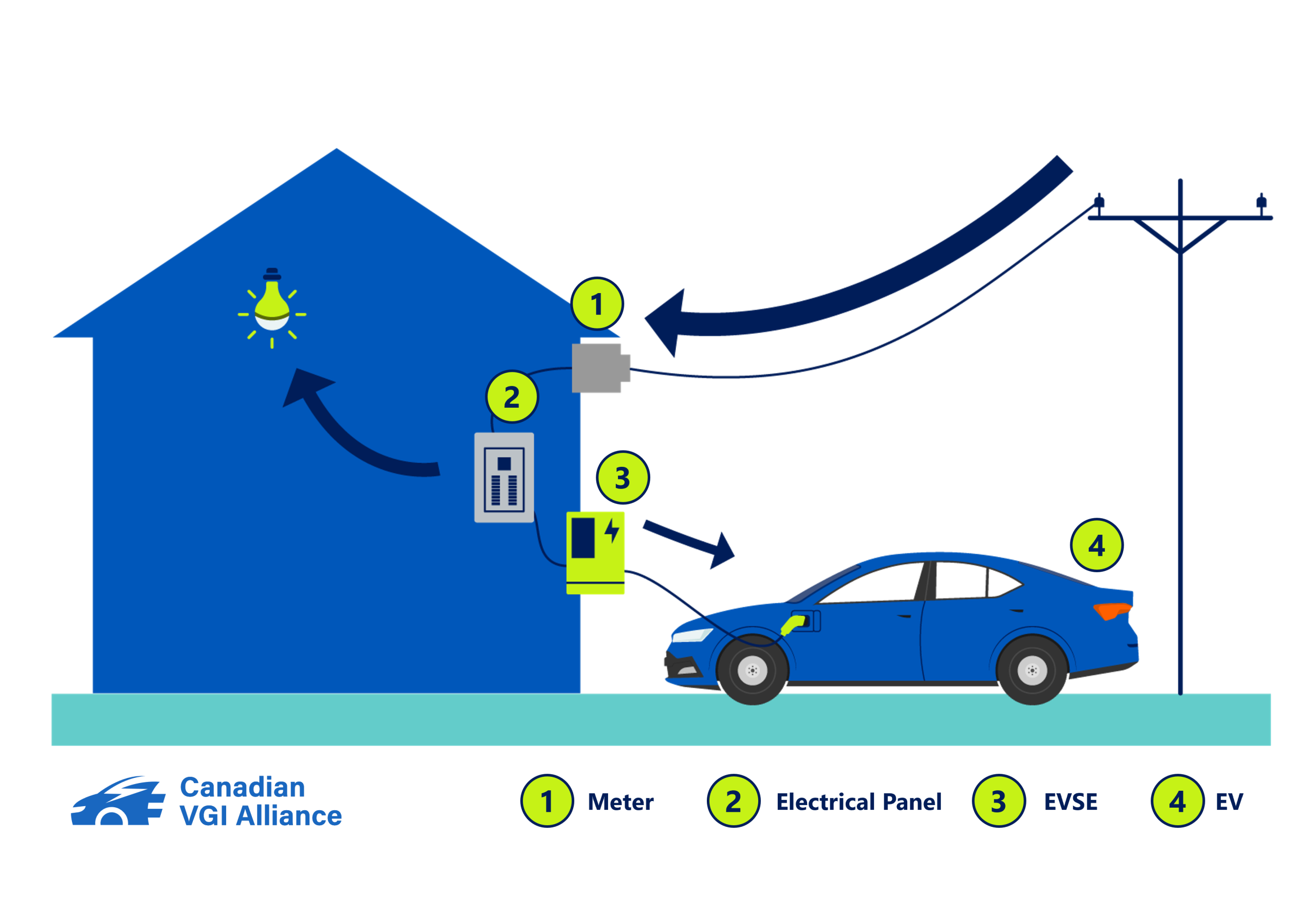
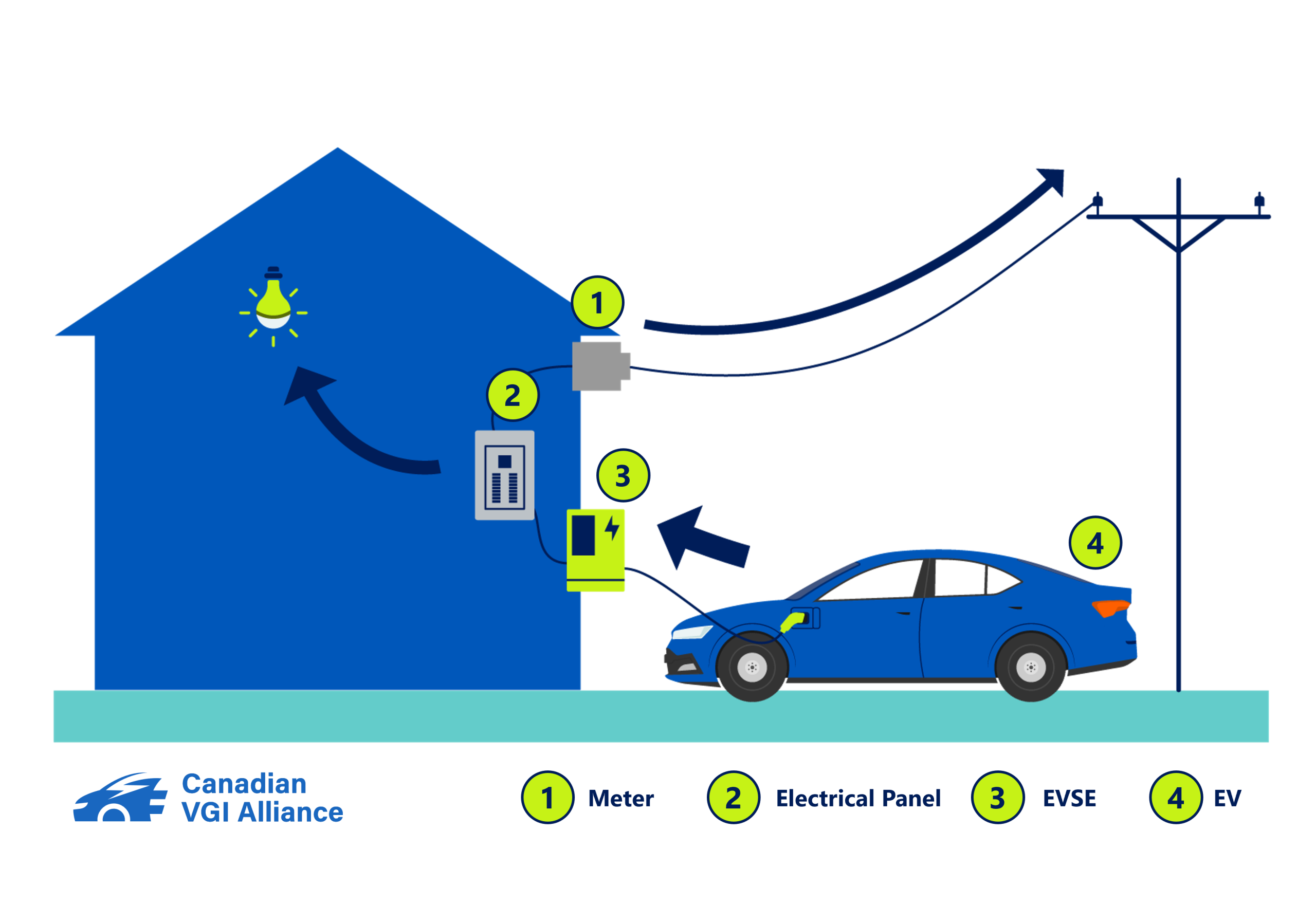
In managed charging applications, or V1G, electricity flows in only one direction: from the charger to the vehicle. However, an EV driver, building or fleet manager, utility, or another third party can manage the timing and rate of vehicle charging to take advantage of lower electricity costs (e.g. Time-of-Use rates, or demand charge management) or to earn money by participating in grid peak-reduction events. Managed charging is enabled by technologies that facilitate communication between the vehicle or charger and that third party – the driver, building manager, utility, etc – like a WiFi-connected EVSE (Electric Vehicle Supply Equipment, aka EV charger) or on-board vehicle telematics.
Additional unidirectional charging VGI applications
Power-efficient design & flexible service connection
Uses controls such as local controls and load management to ensure EV load does not exceed a site or building’s existing electrical capacity, minimizing the need for upgrades. Co-located energy resources, like stationary battery storage, renewable generation, or fossil fuel generation can augment local controls to support flexible service connections.
Co-located stationary battery storage
Often used for vehicles typically parked for short periods and needing to charge quickly, a stationary battery charges from the grid, then the EV draws from the stationary battery. This allows grid charging to be scheduled at times with lower rates or that reduce peaks, while allowing the EV to charge whenever it needs to – this is sometimes called ‘battery-buffered charging’. Co-located stationary storage can also be used for resilience and uptime purposes.
Bidirectional Charging (V2X)
Bidirectional charging applications are collectively known as V2X (vehicle-to-anything). V2G (vehicle-to-grid) is also commonly used as an umbrella term, and you may also encounter the shorthand “bidi.”
Definitions of V2X and related acronyms vary, with no universally accepted standard. Below, we recommend consistent terminology to help establish a common industry language, while noting alternative usages where helpful for interpreting other sources.
Vehicle-to-Load (V2L)
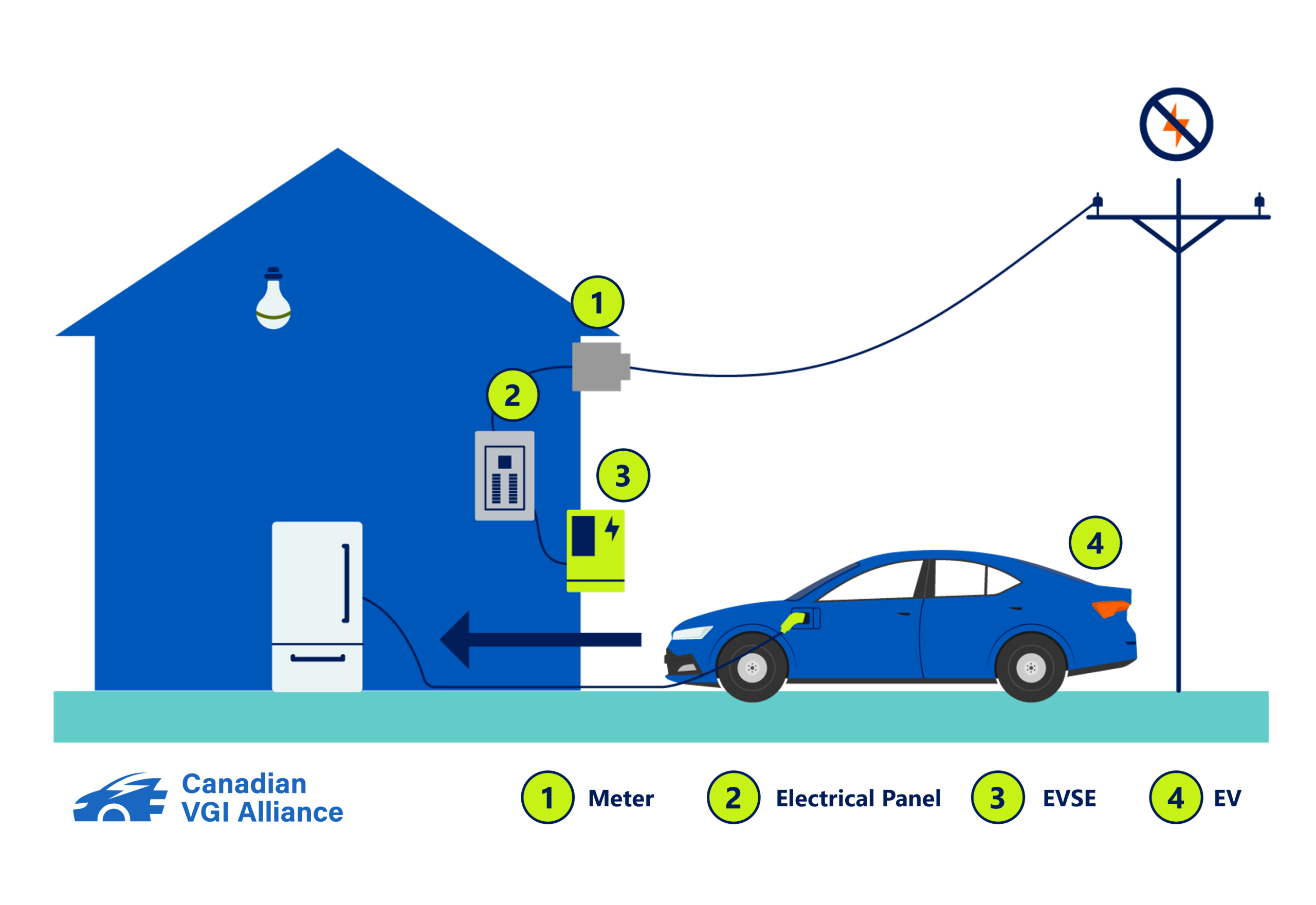
In vehicle-to-load applications, the vehicle may have an onboard power outlet, which may be a regular 3-prong wall outlet or a higher-voltage 4-prong outlet, or may be compatible with a charging port adaptor that offers a regular 3-prong wall outlet. These solutions can be used to power specific appliances or loads, like a laptop, power tools, e-bike or camping equipment. One EV can even be used to charge another.
Islanded Vehicle-to-Home / Vehicle-to-Building (V2H / V2B islanded)
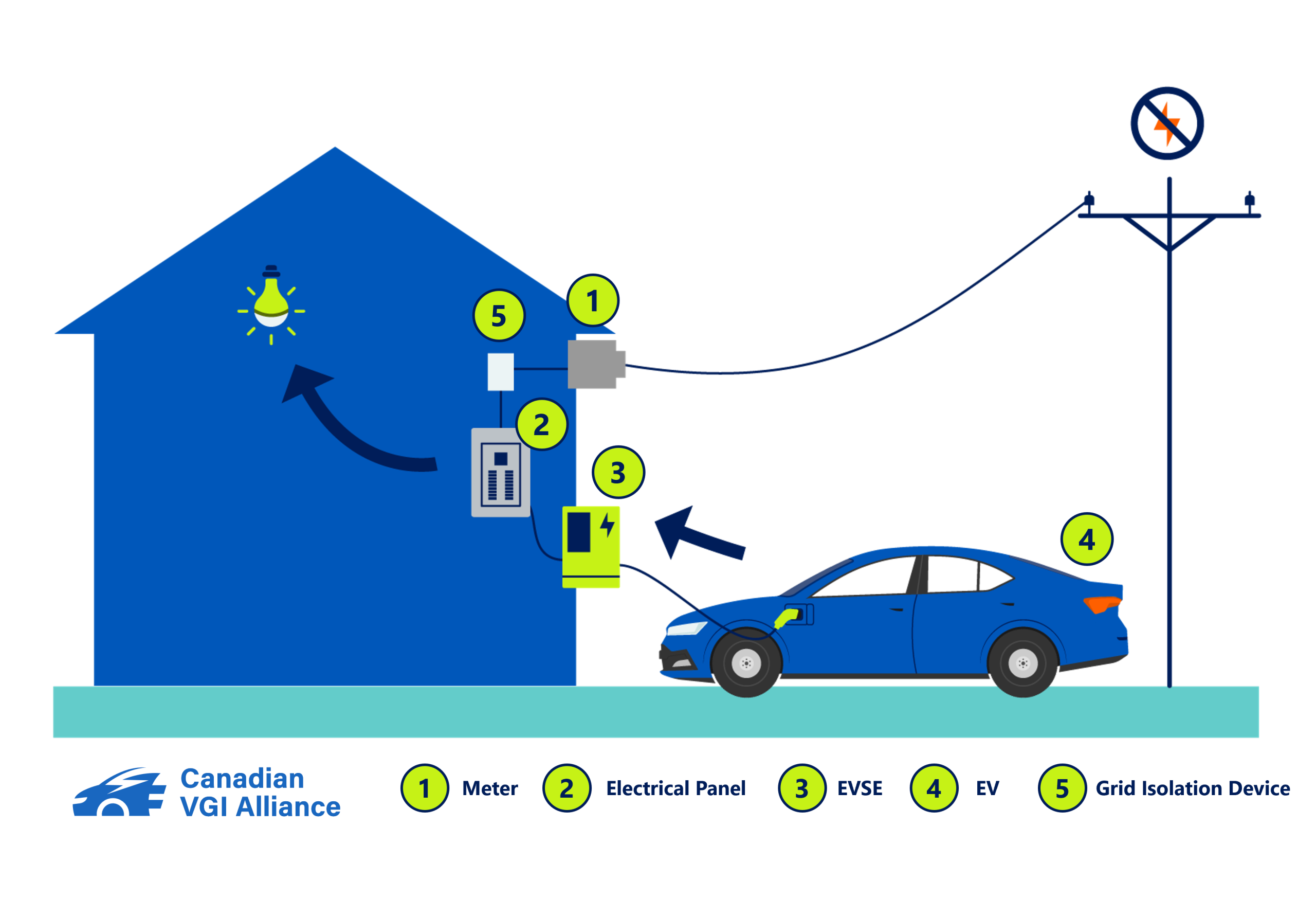
With vehicle-to-home or vehicle-to-building (V2H/V2B*), the EV provides electricity when disconnected (or ‘islanded’) from the grid, typically during an outage as a source of backup power. The system needs a grid isolation device to ensure safe operations, just like traditional backup generators. This application may also be described as grid-isolated, or grid-forming.
*In this Knowledge Centre, V2H/V2B refers specifically to grid-islanded backup power, distinguishing it from grid-connected bidirectional charging (V2G). However, in other industry sources, V2B/V2H can also describe grid-connected applications, so we recommend specifying “islanded” for added clarity. V2B typically refers to larger, non-residential buildings, and is often also used to refer to grid-connected systems. In North America, V2H most commonly refers to islanded backup power, whereas in Europe V2H generally refers to grid-connected applications unless otherwise specified.
Vehicle-to-Grid (V2G)
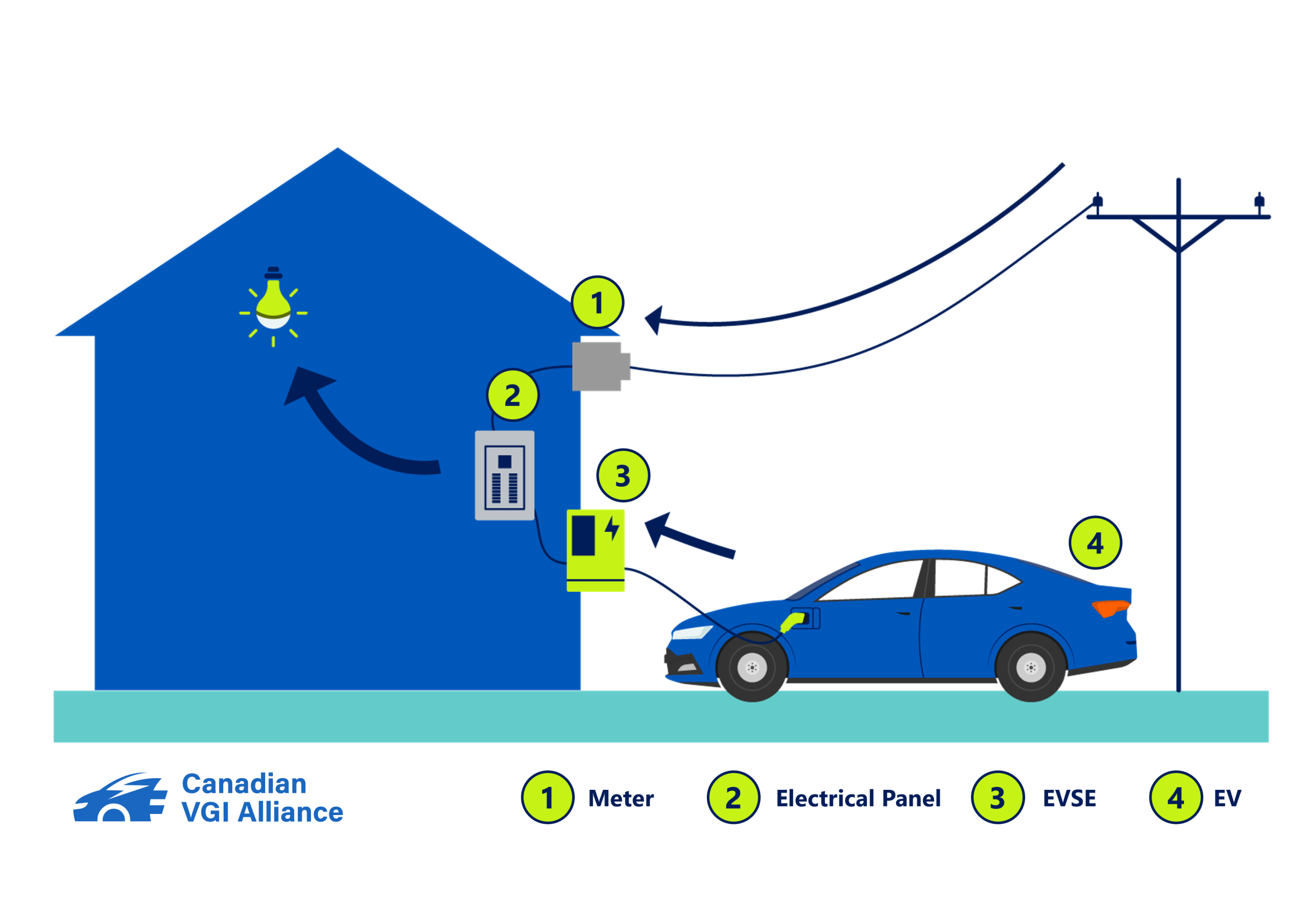
In grid-connected bidirectional charging applications (V2G), the EV exports energy into a grid-connected system. That energy can flow to reduce other building loads connected behind the same meter, can be exported from the meter onto the grid, or can even be directly grid connected (front of meter) in some fleet applications. Drivers can be compensated for this energy through utility incentives, programs, rates or market mechanisms. Grid-connected applications may also be called interconnected, grid-parallel, or grid-following. There are three key types of grid-connected V2G:
V2G (non-exporting)*
The EV supplies electricity to the home or building while connected to the grid, reducing the site’s grid electricity use without sending power back to the grid.
*This application is sometimes referred to as V2H/V2B (interconnected), but given that the vehicle operates as a grid-connected DER – with associated interconnection, safety, and power quality considerations – we use the term V2G Non-Export to distinguish it from both islanded V2H/V2B and V2G applications that permit net export to the grid.
V2G (exporting)
The EV discharges while grid-connected and the site can export energy to the grid.
V2G (front of meter)
The EV discharges and exports directly to the grid, with no connected building and without being behind a customer meter.
Alternating Current (AC) vs Direct Current (DC) VGI
While the electricity grid delivers AC power, EV batteries charge and discharge DC power, which requires electrical conversion equipment. All EVs have an on-board charger which does this conversion for AC charging.
This means there are two types of charging:
- AC charging: The EVSE delivers AC power to the EV at Level 1 (120V) or Level 2 (single-phase 208V or 240V), which are most used in residential applications, as well as fleet and public sites where vehicles are parked for longer periods.
- DC charging: The EVSE includes the AC to DC converter and bypasses the on-board charger, allowing for faster charging without requiring a higher capacity converter in the vehicle. DC charging is used in fleet and public charging applications where vehicles need to charge quickly and are parked for only short periods, as well as for larger fleet vehicles with higher charging power requirements.
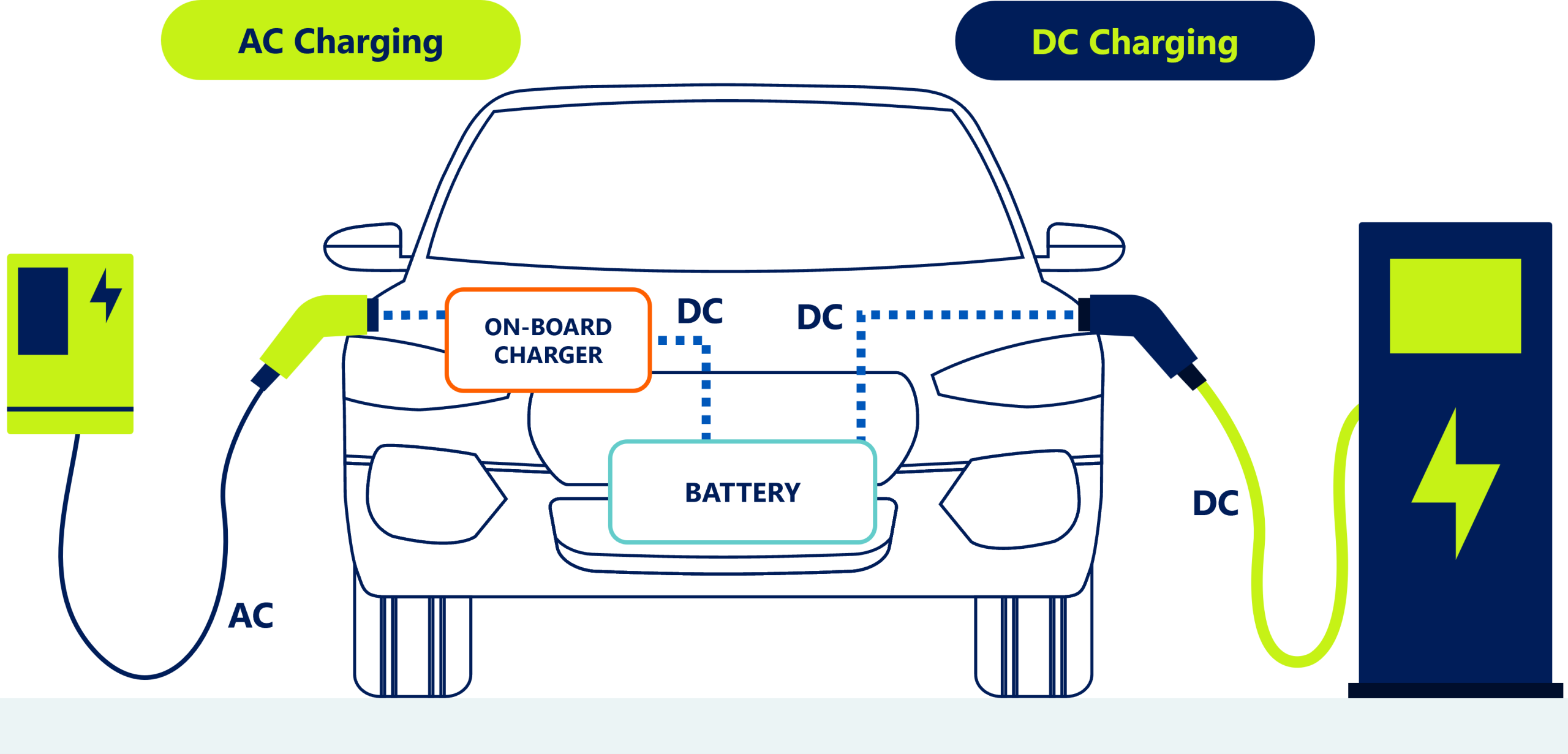
Exporting power, as in the case of bidirectional charging (V2X), from a vehicle for use by AC equipment likewise requires an inverter. Bidirectional charging systems can use an electrical inverter either built into the vehicle itself or external to the vehicle. Where the power conversion occurs on-board the vehicle before discharging, this is called AC bidirectional charging (or “V2X-AC” or “V2G-AC”). Where the charging cable carries DC power off the vehicle and the inverter sits external to the EV (e.g., in the EVSE or as a separate wallbox), this is referred to as DC bidirectional charging (or “V2X-DC” or “V2G-DC”).
To date, V2X-DC is the most common and commercially mature approach. The industry standards supporting V2X-DC are relatively well established from solar PV or stationary battery applications, making it easier for utility grid operators to administer interconnection and certification processes. However, V2X-AC is growing because it is cost-effective for lower-power V2X applications.
Components of VGI Applications
VGI requirements by application
| Requirements | Managed charging (V1G)V1G | V2L | V2H/ | V2G (grid-connected)(grid-conn.) |
|---|---|---|---|---|
| COMPONENTS | ||||
| EV | X | X | X | X |
| Bidirectional EVSE | X | X | ||
| DC to AC inverter | X | X | X | |
| Grid isolation device¹ | X | |||
| Anti-islanding¹ | X | X | ||
| Communications/ | X for active managed charging3 | X for active managed charging/ | ||
| UTILITY SUPPORTS | ||||
| Utility interconnection approval | X only if also configured for grid-parallel bidirectional charging (i.e., “mode switching”)5 | X | ||
| Utility compensation² | X | X | ||
V1G = managed charging · isl. = islanded · grid-conn. = grid-connected
3. For active managed charging. 4. For active managed charging/discharging. 5. Only if also configured for grid-parallel bidirectional charging (i.e., “mode switching”).
1. To power just the home or building during an outage, a grid isolation device is needed to safely allow the building system to operate independently.
2. Managed charging (V1G) and grid-connected V2G are unlikely to be adopted without appropriate utility compensation mechanisms. The primary benefit for vehicle owners is the cost savings and/or revenue potential from providing services to the grid, to offset the associated costs such as capital costs and battery degradation.
Partnerships and key actors
There are multiple actors in a functioning smart charging system (for both unidirectional and bidirectional charging), and multiple partnership and communications models that can be employed to connect all the necessary pieces of technology and data to each other.
Vehicle Manufacturers (OEMs) are increasingly offering data services for their vehicles that give customers access to features like vehicle location monitoring or remote lock/unlock. These services and data connectivity (usually cellular) can also be leveraged to control and monitor charging as well as the vehicle battery’s state of charge (SOC).
Charger Manufacturers (EVSPs) are also able to control and monitor charging with network-connected (usually Wi-Fi) chargers and offer these data services to their customers. Many have also created tools to aggregate chargers across a fleet of commercial vehicles at a site to allow fleet customers to manage charging schedules, or to enroll residential customers in VGI programs.
Aggregators & Distributed Energy Resource (DER) Partnerships bring together various OEMs or EVSPs across different makes and models to create one tool or system that can monitor and dispatch commands to vehicles and chargers. These organizations aim to create a one-stop-shop for utilities and DERMs to access vehicles and other distributed energy resources without the need for multiple software and organizational integrations.
Distributed Energy Resource Management Systems (DERMs) can sometimes act as aggregators or participate in DER partnerships, but their main value comes from being a hub of control and optimization for a utility for all demand-side assets that can also interface with energy markets and make transactions based on utility inputs.
Utilities are experts in their systems and are able to forecast or detect times of peak demand. This information can be used to make load shift requests in real-time or to schedule regular ongoing load management through their DERMs platform. They also often provide the compensation pathways such as incentives and programs that attract customer participation in providing grid benefits through VGI.
Use Cases for VGI
Managed charging can provide the same use cases and value stack as other types of demand response, such as smart thermostats, but with more flexibility. Similarly, V2X can provide the same use cases and value stack as stationary batteries. These include:
Backup Power & Resilience
V2L or V2H/V2B (islanded) systems enable EVs to deliver power to homes, facilities, or devices during grid outages, minimizing customer impact. Since this mostly relies on customer action rather than utility dispatch, it presents an easy entry point for early adoption.
On-Site Energy Management
Managed Charging: Fleet operators and building managers with EVs can use energy management systems to control or optimize EV charging in ways that reduce electricity costs (through time-of-use pricing or demand charge reduction) or to keep total site load under thresholds set based on the electrical capacity and service level of the site.
Bidirectional Charging: EVs can lower net electricity demand during peak times by discharging their batteries to support on-site loads or by participating in utility demand response events. This application does not require continuous grid export and can often be implemented through existing demand flexibility programs, making it a practical near-term use of V2X technology.
Capacity & Distribution Support
Managed Charging: EVs can be leveraged to help reduce distribution or system-level peaks on the grid through active or passive management. In passive management, time-of-use rates and other incentives can be used to motivate drivers to charge outside of peak times, whereas active management allows utilities, fleets, or building managers to control charging more directly to reduce peaks, or benefit from time-of-use pricing in an automated fashion.
Bidirectional Charging: EVs can also supply energy back to the grid to help meet system capacity needs or resolve local distribution issues. This scenario demands greater coordination and operational trust, and may involve longer interconnection approval times than the non-exporting on-site energy management use case. Commercial fleets that return regularly to a central site and follow predictable schedules have proven ideal early candidates for V2G. While aggregated residential vehicles have strong potential because of their long dwell times and substantial combined capacity, they may face short-term obstacles due to higher equipment costs.
Other Grid Services
Grid-connected bidirectional charging (V2G) could facilitate extra grid services like frequency regulation, voltage support, and operating reserves by utilizing the quick response features of EV batteries. These services generally involve sophisticated communications, telemetry, and aggregation, along with suitable market or program structures. Additionally, certain ancillary services may place significantly greater demands on the EV battery, leading to accelerated degradation relative to the above use cases.
